Saturday, May 13, 2017

3 trunks ficus fusion update

6 weeks ago I started to fuse 3 ficus religiosa seedlings. Here is some progression. 
This is how they looked on the fusion day:
This is 3 weeks after fusion
This is now, 3 more weeks later:
Trunks at ground level have practically fused, wire is hardly visible. This is in less than two months!

One trunk is blackened in the bottom by some reason. It doesn't look rotten, just black.
Trees grow vigorously. During this time, they grew from 20cm to 50cm tall. I have to periodically add new wires on the top to keep them connected.
This is full view of the composition, after couple new wires added and some minor defoliation. New leaves grow red first, like the one on top. Later they become green and very large. Since trees were not clones, they look a bit different, have different height and width. I don't think it's a problem, future trimming should equalize them. Currently my plan is to let them grow unrestricted until they reach roof of greenhouse (it's ten more centimeters), then trim top to encourage branch growth. Branches should make trunks even thicker and I can bind them to the main stem as well.

Monday, May 1, 2017

Five ficuses trunk fusion

I grown several specimen of Ficus Religiosa intending to fuse them together from the beginning, and first attempt in trunk fusion is going well so far (I'll update on it later). Now it's time for another one. My plan is to get something resembling these:
The idea is to fuse several trees, let one of them grow straight to make an apex and bend others at different heights to form branches. I measured available plants and made a wire model of today's procedure:
Here are 5 participants, 5 month old Ficus Religiosas, grown from seeds. They were initially sowed in small nursery cell container in December 2016, then in January 2017 I slip potted them to slightly larger containers, and finally in April 2017 slip potted again to a half cut 500ml glasses.
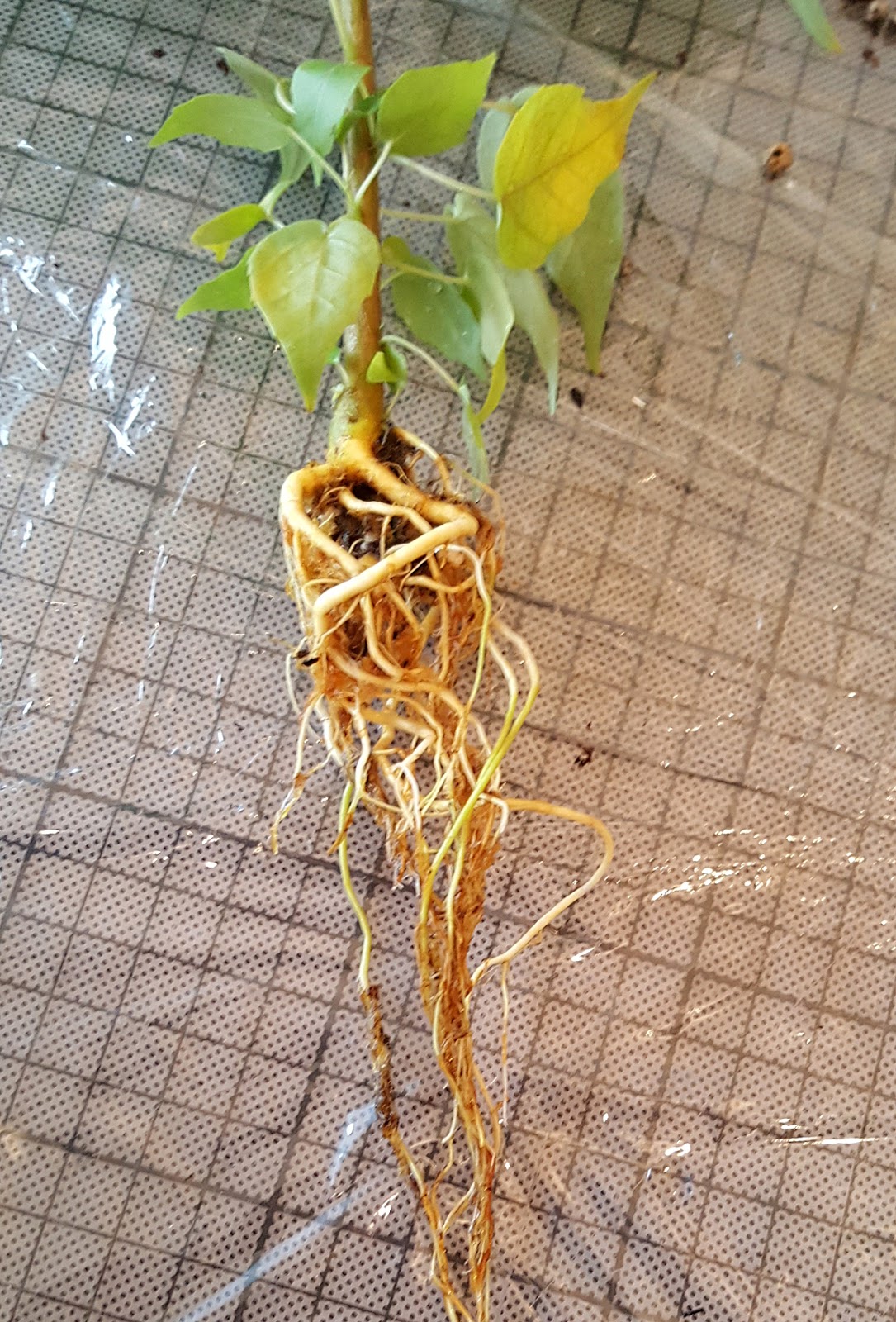
Now it's time for a proper repotting and root maintenance. Slip potting traces were very visible in roots, as kind of layers of root ball density. I pruned the roots removing ones growing downwards and keeping radial structure. Some root balls were relatively modest and easy to clean up:
And some were very messy and large. Especially this one, I spent a lot of time untangling roots and cutting non-radial ones. This plant is 10mm thick just above ground and had even thicker curled roots below. That's what I got after pruning:
Done with roots, I started binding. This time I decided to use rubber bands cut from bike tube instead of steel wire. It's easy to make very tight knots with it and it's supposed to stretch as trunk grows, hopefully not damaging the tree at all. First I bound two trees:
Then added third, the thick one. They actually already look somewhat fused:
I used curly roots of the fatso as additional bonding. Hope that's OK in terms of nebari.
Then I added last two trunks and started to tighten them higher up:
Binding complete:
Another task needed to be accomplished today is wiring. I needed "branches" to grow sideways immediately, because now they are still small and easy to bend and also this way they're going to get more light. That wasn't hard, I used some rubber- and plastic wrapped aluminum wire:
Despite I kept roots moist all the time, the top leaves began to wither by the end of third hour of work. Luckily, it was almost done and after pruning some too large or overlapping leaves I planted the result into a pot. I used a mixture of 50% akadama, 25% compost, 15% pumice and 10% lava rock. Watered generously with root hormone and put to greenhouse.
 Next day it's looking good, withered leaves are stiff again, no visible signs of damage.

Sunday, April 16, 2017

Pruning small trees

Growing trees from seeds have one upside (or downside, it depends) - genetic diversity. Having a number of plants with different genome, I'm trying to take advantage of it. Previously, I've started a 3 trunk fusion, which should make fast growing plants a bit larger. This time I'm going to make slow growing ones even smaller. 
Two smallest ficuses I put into a separate isolated environment, spent there 2 months and developed relatively impressive aerial roots and a multitude of small branches, but were not too interesting otherwise.
So I've decided to experiment with growing very tiny ficuses using these two specimen. 4 days ago I started with repotting:

I performed root pruning, trying to maintain somewhat radial root structure:


After repotting I defoliated them and performed radical pruning:
Four days later, I confirm they've survived and started to regrow some leaves:

Another two seedlings I've root pruned and cut 2 months ago and slip potted a week ago, have grown long but boring branches as well:

I'm not going to touch their roots this time, but I believe it's time for some pruning:

I've left one of two fork branches meaning to make trunk grow sideways. I'm cutting just above leaf nodes expecting cuts to die down to these nodes. I'm keeping couple leaves for these ones to make recovery faster, but eventually I want to keep their leaves small.
I've put cut branches to water with small amount of fertilizer and root hormone to see what happens to them:

Tuesday, March 28, 2017

Ficus trunk fusion

It's time to try some trunk fusion on my Ficus Religiosa seedlings. Currently I have 7 larger 4-month old plants I grew from seeds since last November, and they're looking ready for some training. The tallest plant in 20cm from ground to top leaf node and the thickest trunk is 9mm at just above ground level.
I choose 3 largest ones to work with this time:
First, I mixed some soil. It's my first time soil mixing, so I can't certify it's the best proportions, but I took 45% akadama, 25% pumice, 25% compost mix (it's actually kind of premixed soil, but I believe it contains mostly compost) and 5% sphagnum (because why not, a have a bag of it and some people say it's arguably the best organic soil).
I sieved and washed akadama, it had a lot of fine particles and dust because it's pretty fragile and breaks apart from slightest impact, and surely during transportation.
I din't sieve pumice because it looks much stronger. I washed it though, and there were a lot of dust.


I din't wash compost, because fine particles are basically half of it anyway. That's how the final mix looked like:
Now back to seedlings. They looked somewhat pot bound and deserved repotting anyway. I was not going to root prune them this time, but I had to remove soil out of roots, so some finer roots were lost during this operation.

Combed

After washing
I kept roots in water while working with other plants to make sure they don't dry out:
After stripping roots and removing some bottom leaves, I found optimal way to connect 3 plants and cut all leaves that were looking inside. Then I used 0.5mm steel paper-covered wire to connect first two trunks:
And then added third one. I used pliers for twisting to make sure trunks are connected tight enough.
Then I connected them higher
And higher. At the top I didn't twist too much because trunks were gentle up there.
After binding, I planted the result in a larger pot an cut some of top leaves making sure I don't discriminate any one of plants:
Four days later, a few leaves died out, but the rest look good and new leaves are growing on top, red in color by some reason:

 The color may be due to lack of nutrients, or just a normal thing under plenty of light (last few days were very sunny). Wired connections also look fine: